Saturday, October 11, 2008
Project in Profile - ANMC expansion
Just thought I'd cover some of the lesser known projects well under way throughout the Anchorage Bowl to make up for the lack of fresh developments coverage as construction progress citywide starts to slow now that the grass is turning crunchy with frost in the morning and people rush to Johnson's Tire Service in a last minute panic to get their studded tires on.
One project that took me by a bit of surprise when driving west down Tudor recently is an expansion of the Alaska Native Medical Center. Okay that's not so surprising, especially considering the new building is rising next to the new parking garage. That area of town has certainly become a high-density free-for-all over the last 7 years or so. Kinda like Midtown in the 70s and 80s. One of my favorite restaurants, 'The Last Frontier' fell victim to this progress three years ago as the building was demolished to make way for the now just completed garage. Anyways the new building currently going up will serve as an expansion to the existing Alaska Native Primary Care Center across the street from the Native Medical Center and will be operated by the Southcentral Foundation (which also runs the existing ANPCC). According to the Foundation, the expansion will be 80,000 square feet and will serve to the needs of the growing number of patients relocating from the villages to Anchorage. The new building, or "Phase III" as they call it, is expected to be completed in late 2009.
Of course we haven't seen the peak yet. In an article last year for the Alaska Business Monthly, the administrator with the Alaska Native Medical Center mentions plans in the future for a parking garage north of the hospital along with a $123 million dollar expansion.
(click to view)
Wednesday, October 8, 2008
7th and C traffic lights flick on

The intersection of 7th Avenue and C Street wasn't so much an intersection as it was more of an alley going through a highway. That was until late last week when the traffic lights which were installed later in the summer were uncovered from their protective sheets and put into operation. Since the discussions of an expansion to the Anchorage Museum of History and Art came to the forefront some years ago, the topic of reconnecting the museum to lively West Downtown also became part of that discussion. As my local Anchoragites can attest, while the Egan, Dena'ina, and Performing Arts Center as well as other attractions enjoy a close pedestrian friendly proximity from one another, the Anchorage Museum of History and Art paired with the Federal Building across the street have for many years become excluded from the "in-crowd" of downtown attractions as they sat on the other side of a busy three lane artery that is free of stop signs and where cars coming from the Glenn Highway or the port of Anchorage often accelerate up to 40 mph south toward Midtown. If you're not catching on, C Street is such a wide and divisive road that it has become the unofficial boundary line between West Downtown and East Downtown. Though the city has been making an effort for years now, East Downtown continues to lag way behind the lively West, and I think C Street may be a factor. Now of course a set of lights will not cure all the problems, rather there is still a long way to go; but it's start. Besides the lighted intersection, the proposed controversial Highway to Highway project would keep commuters on the Glenn Highway and direct them into the Seward Highway rather than having traffic leave the highway in large numbers and flooding into C Street like a gush of water breaking through a dam. And it's not just C Street that is a problem. It's also A Street, 5th Avenue, and 6th Avenue. In the meantime, it will be nice to see how things are next summer once the new museum is open and pedestrians are no longer having to make a mad dash to the other side so as to not become roadkill.
Tuesday, October 7, 2008
Title 21 public discussion
This Thursday at noon the Muni will be hosting a brown bag discussion on the Title 21 Rewrite that is open for all who are interested. From the email:
"This is an opportunity to ask questions and learn about Anchorage’s recommended new off-street parking regulations relative to the other site development provisions in Title 21 that are now going forward to the municipal Planning & Zoning Commission for deliberation and action. The brown bag agenda includes a 20-minute presentation and 30 minutes for dialogue, Q and A. Participants will get an overview and have opportunities to ask questions about topics such as:
* How the required number of parking spaces is (and is not) changing;
* Flexible parking standards that recognize different project locations and characteristics;
* How the number of spaces affects user convenience, development costs, location, and Anchorage 2020 policies;
* Balancing quality and quantity: parking space dimensions, landscaping, and lighting; and
* Balancing trip choice: placement of buildings near sidewalks; maintaining driver convenience; required walkways; bicycle parking; share-a-ride and transit"
"The Brown Bag will be from 12 noon to 1 p.m. in the Planning and Development Center's Training Room, 4700 Elmore Road, Anchorage".
For those not in the know, Title 21 is the Municipalities guide that deals with planning and land use codes. It's been 400 years since it was last updated, but with the city adopting the Anchorage 2020 Comprehensive Plan back in 2001, a rewrite of Title 21 is needed in order to carry out what Anchorage 2020 calls for. This includes greater pedestrian friendliness, alternative uses of transportation, and more sustainable use of land. To respond to this, Title 21 is being rewritten with codes that include zoning changes, restrictions on surface parking lots, financial benefits for developers of mixed-use projects, and other new standards. The large stack of papers that is Title 21 is to be reviewed and possibly amended chapter by chapter by the Anchorage Assembly. Several chapters have already been passed, and if I'm correct, there's only a small amount left.
As you can see, I provided a link to the Muni's page on Title 21, but consider yourself warned! Any attempt to read every document relating to Title 21 without getting off your chair is certain to create severe blood circulation problems. If you must read it all, please take breaks and stretch every once in a while.
"This is an opportunity to ask questions and learn about Anchorage’s recommended new off-street parking regulations relative to the other site development provisions in Title 21 that are now going forward to the municipal Planning & Zoning Commission for deliberation and action. The brown bag agenda includes a 20-minute presentation and 30 minutes for dialogue, Q and A. Participants will get an overview and have opportunities to ask questions about topics such as:
* How the required number of parking spaces is (and is not) changing;
* Flexible parking standards that recognize different project locations and characteristics;
* How the number of spaces affects user convenience, development costs, location, and Anchorage 2020 policies;
* Balancing quality and quantity: parking space dimensions, landscaping, and lighting; and
* Balancing trip choice: placement of buildings near sidewalks; maintaining driver convenience; required walkways; bicycle parking; share-a-ride and transit"
"The Brown Bag will be from 12 noon to 1 p.m. in the Planning and Development Center's Training Room, 4700 Elmore Road, Anchorage".
For those not in the know, Title 21 is the Municipalities guide that deals with planning and land use codes. It's been 400 years since it was last updated, but with the city adopting the Anchorage 2020 Comprehensive Plan back in 2001, a rewrite of Title 21 is needed in order to carry out what Anchorage 2020 calls for. This includes greater pedestrian friendliness, alternative uses of transportation, and more sustainable use of land. To respond to this, Title 21 is being rewritten with codes that include zoning changes, restrictions on surface parking lots, financial benefits for developers of mixed-use projects, and other new standards. The large stack of papers that is Title 21 is to be reviewed and possibly amended chapter by chapter by the Anchorage Assembly. Several chapters have already been passed, and if I'm correct, there's only a small amount left.
As you can see, I provided a link to the Muni's page on Title 21, but consider yourself warned! Any attempt to read every document relating to Title 21 without getting off your chair is certain to create severe blood circulation problems. If you must read it all, please take breaks and stretch every once in a while.
Dena'ina Center to operate at a loss

First it was my story on Wasilla's suburban mess, now the ADN is reporting on the new convention center one day after I write a post about it here. Hmmm... are they getting their story ideas from yours truly? Eh.. maybe not. Regardless, the Dena'ina Center makes the front page of Mondays Anchorage Daily News with an article about how although the convention centers backers have been able to show off the buildings on-time completion along with maintaining its promise not to use property tax, the new building along with the Egan Center will operate at a loss for the first full year. To make things more interesting, the $1.47 million that is being projected as a loss into 2009 is way too close for comfort as the cap of funding from bed-tax is set at $1.6 million. Should that cap be exceeded, who will foot the bill? Okay, now that I've got you interested, read the article.
On a related note, another article on one of the art installations that can be found in the building (seen above^, left) thanks to the 1% art program, also from Monday's ADN.
Labels:
Dena'ina Convention Center,
Egan Center,
yours truly
Saturday, October 4, 2008
A look inside the Dena'ina Convention Center

If you didn't go to see some stand up by Damon Wayans and his son Friday at the new convention center, Saturday was your second chance. The Dena'ina Center hosted both the Alaskan Student Youth Conference, and a rally for the McCain/Palin campaign. Though neither event sounded the least bit interesting, that of course didn't stop me from mozying on down and wandering my way around the new building with camera at hand to get some interior shots. Just to remind readers, the Dena'ina Center is no doubt a significant addition to the city's total space for trade shows and conventions. The Anchorage Convention and Visitors Bureau claims the $111 million 200,000 square foot building adds a 300% increase to the total capacity the city can handle in convention and civic space. A look inside the building will make you convinced as it has for me. Despite the convention center occupying only one city block rather than 3 in a earlier proposal (which was voted down by residents due to its original finance scheme), the interior is ridiculously huge and will have to make you wonder what kind of trade show or event will demand the use of every room in the building. Unlike the Egan Center, the ceilings are much higher on each floor while the lobby at the entrance has a dramatic canyon effect in which there's nothing between the ground floor and the very top of the building. Most noticeably however, is the amount of natural light th
at floods into each floor of the building. Even on a cloudy day, you don't sense any need for artificial lighting to be on. I don't even recall whether the lights in the main hallways were actually on or not. This use of natural light really makes the building a nice alternative to the dark windowless Egan Center and Sullivan Arena. In a departure from its older brothers, even the main exhibition hall has windows. But before you even plot, no, you can't watch whatever is happening in the hall from the streets. Trust me, I figured it was a defect and that I can watch Damon Wayans through the window with a glass cup to my ear. Sadly that wasn't to be. Each window has giant blinds that can be pulled down come showtime. And yes, they were sadly pulled down. In the end, the new convention center brought me back to when the Terminal C Concourse at the airport opened three years ago. The modern minimalist architecture combined with an intense amount of natural light for a non-airport building is a first for a public building in the city (though it won't be the last once the new museum expansion opens a few blocks east). Before I sign off for today, I gotta mention that the Dena'ina Center was added by someone to the website of ClubPlanet -- a directory for nightlife hot spots. Here's what they say in a brief review:"Dena''ina Center - Beer? Check. Newspapers? Check. Dena''ina Center, at 600 W 7Th Ave, offers your usual selection of imports, domestics, and so on. Craaaaazy, out-of-control entertainment? Ummmm… Not so much. Your odds of meeting "the one" here are approximate to what you’d find on a desert island (less, when you consider "Lost"), but your odds of finding a six-pack are damn near 100%".
By the way, an open house to the public will be held October 18th just before the AFN conference begins. I shall return!
(click to view)


I can't say I'm surprised by the review. Had the Dena'ina Center failed to supply me with an abundant amount of newspapers and beer that morning, I would have to question the motives and integrity of the developers behind this building. As for the "craaaaazy" out-of-control entertainment, I beg to differ! Clearly they didn't see Hobo Jim entertain the crowd at the McCain/Palin rally.
By the way, an open house to the public will be held October 18th just before the AFN conference begins. I shall return!
(click to view)


Sunday, September 28, 2008
F Street improvements complete
Although the F Street Connectivity Project actually came to a conclusion two weeks ago along with the Pacillo Parking Garage, I figured I'd dedicate a post solely to the new and improved F Street which is looking pretty nice on a rare sunny afternoon (for those of you outside the state, we've been having some rough weather). Like I said in an earlier post regarding the Dena'ina Center which sits on F Street, the area now feels like another city. New street lights, lamps, concrete designs, benches, bike racks, trash cans, and knee-capers (at least that's what I call them after a bad personal experience) have made the area blossom into a little oasis of 21st century urbanism that is certainly needed in a city that many dub "Los Anchorage" for its car-culture and fast paced low quality expansion south of Downtown. One thing that caught me off guard as I didn't really noticed it on the blueprint is the absence of curbs between the sidewalk and street. The whole surface of F Street is now leveled with only the colored concrete and knee-capers to the side differentiating between the street and sidewalk. Personally I'm kinda nervous of such a move as wise people will know never to underestimate the ability of Anchorage drivers to somehow screw up. If there's a will, they'll certainly find a way to make planners shake their heads. I'm reminded of when the South Anchorage neighborhood of South Port got its first roundabout a few years ago. Instead of turning to the right, some drivers gave up and drove straight over the grass island. If you're going to screw up on a roundabout, at least make the mistake of turning left, but going straight??? Anyways, one thing that appears to be missing is the canopy to hang over a portion of the sidewalk on the left side looking north. Was that plan scratched? Not that it was very important, at least for me anyway. All in all, I think the biggest winners from this project were the businesses that line the street. Sub Zero Micro Lounge, Dark Horse Coffee, and Stephens Fine Arts now have a sidewalk much larger than the one found on G Street. By the way, the new looks of F Street are expected to be child's play compared to the very liberal improvements that will come with the E Street Corridor Project. That's the project construction fanatics will be really looking forward to. Anyways, some additional pics for ya of the new F Street:
(click to view)


Saturday, September 27, 2008
America's newest whipping boy: Wasilla
Being that this is a blog based out of Alaska, I suppose I'd have to acknowledge at some point that my governor is running to be the second most powerful person on Earth. With that, these last three weeks or so have been quite amusing as we Alaskans watch the world's discovery of Wasilla (Sarah Palin's hometown for those of you living in NORAD) like rubberneckers at the scene of a car accident. It may be ugly to watch... but we have to watch! And oh is it ugly! As my fellow Anchoragites can attest, Wasilla has long been the whipping boy of our city as the lower income blue collar town of some 9000 residents is home to several taxidermy services, "saloons" instead of bars, and our favorite place to shop -- "Knik Kountry Liquor". Over the years, our young sister city in the Valley has not faired so well in fixing its image crisis. As Anchorage physically matures in its urban appearance, many of the trailer mobile homes being removed to make way for office buildings have been known to relocate to Wasilla which welcome trailers with open arms. Mobile homes headed down the highway to Wasilla... not the greatest image a town would want in the minds of potential residents and businesses. And as the national and international media parachute into town since McCain's choice of Palin as VP late last month, they too are now being exposed to the creepy crawly creature that is Wasilla, Alaska. But it's not just the issues of Palin's former church, or the high amount of underground meth labs that has the media talking in negative light about this town. It's also Wasilla itself and its urban
"...A town that is a soulless strip mall without sidewalks" is how New York Times columnist Maureen Dowd gently put it when describing the urban scenery of our beloved Wasilla during a recent visit to the 49th state. The Wall Street Journal had a great article that went into detail about Wasilla's urban dilemma as it goes through the growing pains of fast paced suburbanization at the cost of making long time residents feel out of place while also loosing its honor as the starting line of the annual Iditarod dog sled race due to so many driveways and roads being cut through the Iditarod trail. "Wasilla has neither a planning nor a zoning board, and it shows", wrote Michael M. Phillips for the WSJ article. I think I most enjoyed the piece written by The New York Observer's Joe Conason who when interviewing a local school official (who shall remain nameless) proceeded to tear her own hometowns pride to shreds:
"Wasilla is a hellhole, even by Alaskan standards, where there are plenty of hellhole towns and villages. Wasilla is an ugly place that shows a complete absence of planning, design, or sense of public vision".
You know your city is bad when not only does it meet the basic hellhole requirements, but also impresses the Alaskan Division of Weights and Measurements in meeting the local standards of what constitutes a true All-Alaskan hellhole (North Pole, Alaska is #1). But to stop this from becoming a ba
With this in mind, can Wasilla ever pick itself up and plan for the future in a time where gas prices are continuing to rise, environmental concern is now mainstream, and the automobile backlash is sweeping towns and cities across the country? Maybe so, or maybe not. Maybe not in that an article from Newsweek interviewed a Wasilla city-planner who tells the story of a man back in the 1980s who was fired and had his effigy burned in the parking lot of the city office after attempting to tweak and add restrictions to the city's comprehensive plan. But then again, maybe there is hope. Plans are in the works for the Valley's first town center. Though totally artificial and nowhere near the center of town, Creekside Town Square could be promising. But then again the proposal is already swept into political scandal involving the mayor of Wasilla and a deal cut with the developers while The Frontiersman reports that the development will look more like the sprawl retail already found up and down the Parks Highway. Add to that the major disappointment of what Glenn Square in Anchorage has become in terms of being pedestrian friendly along with the plans falling apart for Muldoon's town center. Whatever the case, if Wasilla thought being the whipping boy of Anchorage was harsh, they might wanna prepare for the long term when it comes to how the Lower 48 will critique their towns physical appearance should Sarah Palin's star continue to shine nationally in the decades to come.
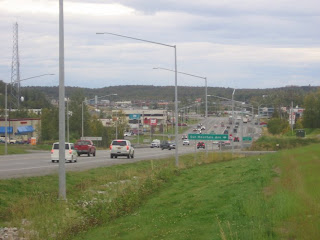
a leasing ad for Wasilla's Creekside Town Square:
Labels:
national media,
urban sprawl,
Wasilla,
whipping boy
Sunday, September 21, 2008
JL Tower's LED display finally gets its due
I was kinda surprised as I picked up the Sunday edition of the ADN this morning to see that the LED lighting of the new JL Tower made the front page. Ermm... the penthouse of the new building has been lit with blue, green, and even red (for a short time) since the dark nights of December '07. So why report on the towers colorful floodlights now? Well apparently the lighting show has finally been tuned after tweaking around with the display since late last year. Okay, well that's cool. What I find really appealing about the buildings nighttime appearance however, is the white floodlights from the ground that brighten the entire building facade. Despite making the building look as if it's clamoring for even more attention, I really liked the idea of bathing the whole facade in light (just as long as it's on only for the early evening and not the entire night). Anyways so todays article goes on to interview the developers at JL Properties as they talk about how they have used recycled materials as tabletop counters, exercise rooms for employees, a Kaladi Bros. cafe, blah blah blah. I guess what I found really amusing was the urban analysis that a consultant who was interviewed for the article used when describing the future prosperity of the area where the JL Tower sits:
"The building is a harbinger of what's to come... The area is attractive to builders because of its expanses of undeveloped land, especially compared to crowded downtown".
Expanses of land? More than half of the available land in that area is gone! Unlike downtown, which has public parking garages readily available to the benefit of developers, the developers behind 'Plaza 36' squandered the former trailer park neighborhood with acres of surface parking lots for their buildings. Each of the parking lots for the JL Tower, ASRC, and Centerpoint Plaza have a larger footprint than the building itself. From the appearance of it, it seems only the new Alutiiq Plaza and the AlaskaUSA Financial Center have more building and less parking (I could be wrong though). Anyways the consultant goes on to say:
"From a public transportation point of view, it makes sense to concentrate offices in one area because it's easier for workers to take the bus".
If we're going to talk about it from a public transport point of view, I think it would have been preferable that the buildings in the Plaza 36 area give up some of their ego and join the heart of Midtown rather than be on the edge of Midtown in a sea of asphalt. In other words, do what the developers behind 188 West Northern Lights did and build a tower that truly cares about the future of Anchorage. Unlike the JL Tower, 188 WNL is situated between Northern Lights Boulevard and Benson in front of C Street -- perhaps the most visible location in the city today. The building offers space for ground floor retail while the parking garage is snugged quietly into the building. A first for Anchorage that deserves positive recognition. Instead of the People Mover bus making a detour to serve the new Plaza 36 office park on the edge of Midtown, workers in the JL Tower could have walked to existing bus stops already in place in the heart of Midtown, had the JL Tower been located there instead of the edge. With that, here's a map that shows the remaining land available for the developers at JL Properties when including surface parking:
click to enlarge

"The building is a harbinger of what's to come... The area is attractive to builders because of its expanses of undeveloped land, especially compared to crowded downtown".
Expanses of land? More than half of the available land in that area is gone! Unlike downtown, which has public parking garages readily available to the benefit of developers, the developers behind 'Plaza 36' squandered the former trailer park neighborhood with acres of surface parking lots for their buildings. Each of the parking lots for the JL Tower, ASRC, and Centerpoint Plaza have a larger footprint than the building itself. From the appearance of it, it seems only the new Alutiiq Plaza and the AlaskaUSA Financial Center have more building and less parking (I could be wrong though). Anyways the consultant goes on to say:
"From a public transportation point of view, it makes sense to concentrate offices in one area because it's easier for workers to take the bus".
If we're going to talk about it from a public transport point of view, I think it would have been preferable that the buildings in the Plaza 36 area give up some of their ego and join the heart of Midtown rather than be on the edge of Midtown in a sea of asphalt. In other words, do what the developers behind 188 West Northern Lights did and build a tower that truly cares about the future of Anchorage. Unlike the JL Tower, 188 WNL is situated between Northern Lights Boulevard and Benson in front of C Street -- perhaps the most visible location in the city today. The building offers space for ground floor retail while the parking garage is snugged quietly into the building. A first for Anchorage that deserves positive recognition. Instead of the People Mover bus making a detour to serve the new Plaza 36 office park on the edge of Midtown, workers in the JL Tower could have walked to existing bus stops already in place in the heart of Midtown, had the JL Tower been located there instead of the edge. With that, here's a map that shows the remaining land available for the developers at JL Properties when including surface parking:
click to enlarge

Wednesday, September 17, 2008
Knik Arm Crossing resolution stalls
With the national media now beginning to take notice on that other bridge to nowhere, Tuesday night saw the resolution asking for the Assembly to drop the bridge from its long range transportation plans stall a bit. It may first sound unbelievable when you hear that the Anchorage Assembly voted unanimously for the resolution, but before you react, there's some details you gotta know. Assembly members Dan Coffey and Chris Birch removed wording from the resolution that asks for the Assembly to immediately drop the Knik Arm Bridge from the city's transportation agenda. Instead, the bridge is to be re-reviewed by AMATS (the state and city transportation board) and again put before public testimony. Sheila Selkregg, when interviewed on Channel 2 later in the night, remained optimistic as she pointed out that the resolution still retains its ultimate motive of seeking whether the bridge should be dropped.
So it looks like we will see a repeat of what we saw in 2007 when the then conservative Assembly added the Knik Arm Bridge to the city's long range transportation plans. In other words, we will see more testimony from KABATA (the bridge and toll authority overseeing the project) as they answer questions such as the costs and environmental impact, while another public testimony before the Assembly is expected later. Unlike 2007 however, I predict the results will be different in that we will indeed see the bridge knocked out of the AMATS agenda of fund worthy projects. Why? Well as I've said in my previous entry, times have changed. I'm willing to go as far as to say the bridge today is more unpopular than it was last year. And if you were at the Assembly last year during public testimony like I was, then you know how passionately Government Hill residents and others were against this project. Supporters of the bridge in last years public testimony were a small minority. But now one year later, George Wuerch, the former mayor appointed to lead KABATA, has resigned. Henry Springer (or as I call him, Henry Kissenger's long lost brother) , who was KABATA's spokesman, also left along with the deputy director (who shall remain nameless since I don't know his name). On top of that, the issue of federal earmarks and bridges to nowhere are returning to the national headlines thanks to Sarah Palin, while gas prices have soared bringing Mayor Begich to sign a deal with Mat-Su Borough Mayor Menard to establish a regional transit authority earlier this summer. In other words, it appears this will be a slower death blow for the bridge rather than a fast one. Even without considering the outside factors that have occurred since last year, the Assembly has the votes to please Mrs. Selkregg and Patrick Flynn. It's not the public that decides in the end whether the bridge stays on the AMATS board. Here's my prediction on the voting that will probably take place later this year after public hearings:
Flynn: Drop the bridge
Drummond: Drop the bridge
Gray-Jackson: Drop the bridge
Sheila Selkregg: Drop the bridge
Claman: Drop the bridge
Gutierrez: Drop the bridge
Coffey: Keep the bridge
Starr: Keep the bridge
Birch: Keep the bridge
Ossiander: Keep the bridge
Johnston: Keep the bridge
Mayor Begich: Drop the bridge
Unlike last year, Drummond, Gray-Jackson, and Gutierrez have all replaced formerly conservative seats. In 2006, Selkregg replaced conservative Ken Stout (who was a very scary guy when looking at his philosophy of how urban development should be). Again though, I just wanna stress that if and when the Assembly drops the bridge, this will NOT be the end. After this, it will be up to Governor Palin to reallocate the federal money upon Assembly request.
So it looks like we will see a repeat of what we saw in 2007 when the then conservative Assembly added the Knik Arm Bridge to the city's long range transportation plans. In other words, we will see more testimony from KABATA (the bridge and toll authority overseeing the project) as they answer questions such as the costs and environmental impact, while another public testimony before the Assembly is expected later. Unlike 2007 however, I predict the results will be different in that we will indeed see the bridge knocked out of the AMATS agenda of fund worthy projects. Why? Well as I've said in my previous entry, times have changed. I'm willing to go as far as to say the bridge today is more unpopular than it was last year. And if you were at the Assembly last year during public testimony like I was, then you know how passionately Government Hill residents and others were against this project. Supporters of the bridge in last years public testimony were a small minority. But now one year later, George Wuerch, the former mayor appointed to lead KABATA, has resigned. Henry Springer (or as I call him, Henry Kissenger's long lost brother) , who was KABATA's spokesman, also left along with the deputy director (who shall remain nameless since I don't know his name). On top of that, the issue of federal earmarks and bridges to nowhere are returning to the national headlines thanks to Sarah Palin, while gas prices have soared bringing Mayor Begich to sign a deal with Mat-Su Borough Mayor Menard to establish a regional transit authority earlier this summer. In other words, it appears this will be a slower death blow for the bridge rather than a fast one. Even without considering the outside factors that have occurred since last year, the Assembly has the votes to please Mrs. Selkregg and Patrick Flynn. It's not the public that decides in the end whether the bridge stays on the AMATS board. Here's my prediction on the voting that will probably take place later this year after public hearings:
Flynn: Drop the bridge
Drummond: Drop the bridge
Gray-Jackson: Drop the bridge
Sheila Selkregg: Drop the bridge
Claman: Drop the bridge
Gutierrez: Drop the bridge
Coffey: Keep the bridge
Starr: Keep the bridge
Birch: Keep the bridge
Ossiander: Keep the bridge
Johnston: Keep the bridge
Mayor Begich: Drop the bridge
Unlike last year, Drummond, Gray-Jackson, and Gutierrez have all replaced formerly conservative seats. In 2006, Selkregg replaced conservative Ken Stout (who was a very scary guy when looking at his philosophy of how urban development should be). Again though, I just wanna stress that if and when the Assembly drops the bridge, this will NOT be the end. After this, it will be up to Governor Palin to reallocate the federal money upon Assembly request.
Subscribe to:
Posts (Atom)